
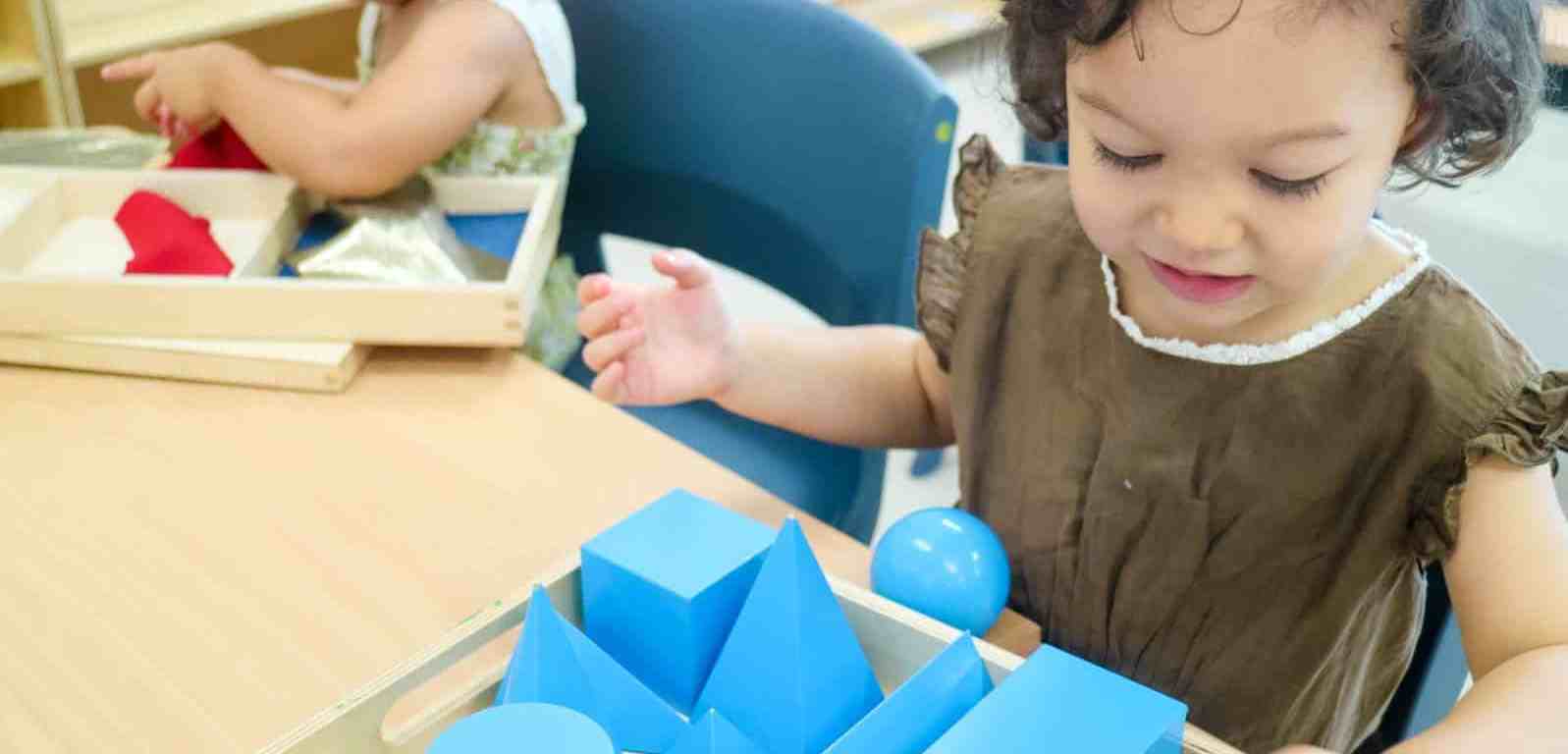
When it comes to early childhood education, few tools are as powerful as the Montessori materials. Among them, the Montessori Geometric Solids stand out as a favorite. These smooth, wooden 3D shapes might look simple at first glance, but they open a whole world of learning—helping children understand geometry, refine their senses, and build a foundation for future math and science concepts.
If you’re a parent or teacher curious about how to introduce these solids to children, you’re in the right place. Let’s break it down step by step so you can feel confident and see your child engage with these beautiful materials in a meaningful way.
What Are Montessori Geometric Solids?
The Montessori Geometric Solids are a set of 10 three-dimensional shapes, often made of wood. They typically include:
- Sphere
- Ovoid (egg shape)
- Ellipsoid
- Cube
- Rectangular prism (or rectangular parallelepiped)
- Triangular prism
- Square-based pyramid
- Triangular-based pyramid
- Cone
- Cylinder
These solids are designed to be smooth, uniform, and appealing to little hands. They help children explore shape, form, and dimension in a concrete, tactile way.
Why They Matter in Child Development
Children are naturally curious about the world around them. When they roll a ball, stack blocks, or look at a building, they’re already interacting with geometric concepts. The Montessori Geometric Solids take this natural interest and guide it into structured exploration.
- Hands-on learning: Kids get to hold, roll, and compare each solid, which makes abstract concepts real.
- Language development: Children learn precise vocabulary like “sphere,” “cylinder,” and “cone.”
- Pre-math and pre-science skills: The solids prepare children for geometry, measurement, and spatial reasoning later in school.
- Refined observation: Handling the solids sharpens a child’s ability to notice details in everyday objects.
How To Introduce the Montessori Geometric Solids
Here’s a simple, practical approach to presenting the solids at home or in the classroom.
Step 1: Create a Calm Environment
Children learn best in a peaceful, uncluttered space. Choose a quiet moment and a child-sized table or floor mat. Make sure the solids are placed in a simple basket or tray.
Step 2: Start With Three Solids
Montessori emphasizes simplicity. Begin with three very different solids—for example, the sphere, cube, and cone. Place them in front of the child.
Step 3: Naming the Solids
Pick up one solid at a time. Slowly say its name: “This is a sphere.” Hand it to the child so they can explore it. Do the same with the others.
This is called the Three-Period Lesson:
- Naming: “This is a cube.”
- Recognition: “Show me the cube.”
- Recall: “What is this?” (child answers).
Step 4: Encourage Exploration
Allow the child to feel, roll, and compare the solids. Ask gentle questions:
- “Which one can roll?”
- “Which one has flat sides?”
- “Which one feels smooth all over?”
Step 5: Relating Solids to Real Life
Connect the shapes to everyday objects:
- Sphere → a ball
- Cylinder → a can of soup
- Cone → an ice cream cone
- Cube → a dice or building block
This helps children see geometry in their environment.
Step 6: Expand Gradually
Once the child is familiar with the first three, slowly introduce the rest of the set. Keep presentations short and positive, always letting the child lead with curiosity.
Tips for Success
- Follow the child’s pace: Some kids will want to explore longer; others will move on quickly. Both are fine.
- Use precise language: Always use the correct geometric name, even if it feels advanced. Children absorb vocabulary naturally.
- Keep it hands-on: Resist the urge to lecture. Let the materials do the teaching.
- Repeat often: Repetition strengthens memory and builds confidence.
Using Geometric Solids Beyond the Lesson
The beauty of the Montessori Geometric Solids is that they grow with your child. Here are a few ways to extend their learning:
- Art projects: Use solids as models for drawing or painting.
- Building play: Combine them with blocks to explore structures.
- Sorting and matching: Match solids with pictures of real-life objects.
- Early math: Use them to introduce concepts like edges, faces, and vertices.
FAQs About Montessori Geometric Solids
- At what age should I introduce the Montessori Geometric Solids?
They are typically introduced around ages 3–6, but children of different ages can benefit depending on their interest and readiness. - Do I need the full set right away?
Not necessarily. Starting with just a few solids (like the sphere, cube, and cone) is perfectly fine. You can build the collection gradually. - My child doesn’t seem interested. What should I do?
Don’t force it. Simply leave the solids accessible on a shelf. Children often return to materials when they’re ready. - Are Montessori Geometric Solids only for math?
No. They support language, art, observation, and even practical life skills as children begin to recognize shapes in the world around them.
Conclusion
The Montessori Geometric Solids may look like simple wooden shapes, but they unlock a deeper understanding of the world for children. By exploring these solids, kids learn the language of geometry, develop problem-solving skills, and build confidence in observation and communication.
At Dannico Woodworks, we understand that the right learning tools, combined with safe and thoughtfully designed furniture, create an environment where children thrive. Just like our furniture, the Geometric Solids encourage independence, creativity, and exploration—giving kids the space and tools they need to grow.
So, if you’re looking to spark curiosity and nurture learning, why not start with something as simple yet powerful as a sphere or cube? The question is: Which shape will your child discover first?
 My Family Blog